
About us
Technical ability multiplied by commercial understanding.
We work with businesses to identify repetitive, labour-intensive and time-consuming processes, then design software and automation to improve them.
Why RareSquared Labs exists
Businesses lose time and money through processes that have become unnecessarily manual. Systems were added one at a time, workarounds became habits, and nobody has since stepped back to ask whether the work still needs to be done that way.
We do not begin with a pre-packaged product and try to force it into the business. We begin by understanding how the team currently works and where time is being lost.
Who we are
John Durkin
Mechanical engineering, commercial experience and software development — brought together to solve real business problems.

Engineering thinking from the beginning
John’s route into technology began long before Rare² and long before today’s AI boom. He started programming as a teenager on a Sinclair ZX Spectrum, developing an early interest in understanding how systems worked and how technology could be used to solve practical problems.
His professional background began in mechanical engineering and the automotive industry. That engineering foundation still influences the way he approaches technology today: understand how something works, identify what is unnecessary, remove waste, simplify the process and only then decide what technology is actually needed.
Early internet and e-commerce
During the early commercial internet, John taught himself web and software development and became an early adopter of e-commerce, building online commercial systems at a time when selling products and taking payments over the internet was still relatively new in the UK.
He later enrolled at Liverpool John Moores University to formalise his technical education. After only four days, following extensive technical discussions with lecturers, it became clear that much of the introductory material overlapped with knowledge and practical development experience he had already built independently.
John therefore continued developing his technical skills through real commercial projects, independent learning and building working systems.
Alongside technology, John has accumulated decades of practical business experience across management, sales, automotive finance, customer service, procurement, logistics, aftersales, maintenance, e-commerce, marketing and advertising .
His experience also covers the numbers behind a business: margins, costs, ROI, statistics, data handling, reporting, analysis and forecasting .
Since 2012, he has worked in automotive sales and finance management, dealing directly with customers, lenders, commercial decisions and the day-to-day realities of running a busy operation.
Building and operating a real digital business
That combination of commercial and technical experience led John to build and operate Motorhome Stopover Club, a live subscription-based digital business with more than 6,700 UK stopover listings.
John has developed its website, membership systems, payments, search tools, trip-planning features, customer journeys, SEO, content, automation and continuing product development.
It demonstrates an important part of his experience: taking a digital idea through development, launch, monetisation and ongoing operation with real paying customers.
Problem first. Code first. AI only where it adds value.
John does not start a business problem by asking which AI model should be used. He starts by asking whether the process itself is right.
Only after those questions have been answered does automation or AI earn its place.
Sometimes the right solution is conventional software. Sometimes it is automation, a local AI model, a larger model, a cloud service, human review — or a carefully designed combination of them.
Technology built around the problem
The same philosophy can be applied across a wide range of business operations. Rare² can build systems around customer enquiries, AI receptionists, email automation, lead management, accounts workflows, invoices, purchase orders, paperwork digitisation, data extraction, structured databases, dashboards, reporting and integrations between existing systems.
The point is not that Rare² sells one particular type of software. The starting point is the operational problem. The technology is then selected and built around what the business actually needs.
What John does at Rare²
John has helped design and build the Rare² Manufacturing Discovery platform, which follows real work through a business, identifies where time is being lost and converts observations into measurable operational and commercial opportunities.
He has also developed the commercial and process logic behind Rare²’s Business Process Assessment tools and remains directly involved in designing, prototyping and testing the software and automation systems developed by the company.
His role within Rare² sits at the point where engineering, software and commercial reality meet. He leads process discovery, product direction, ROI analysis, customer journeys, rapid prototyping, commercial strategy, partnerships and commercialisation.
Jamie Siddall
Software engineering, AI architecture and deep hands-on experience with local language models — focused on building practical systems that work reliably in the real world.
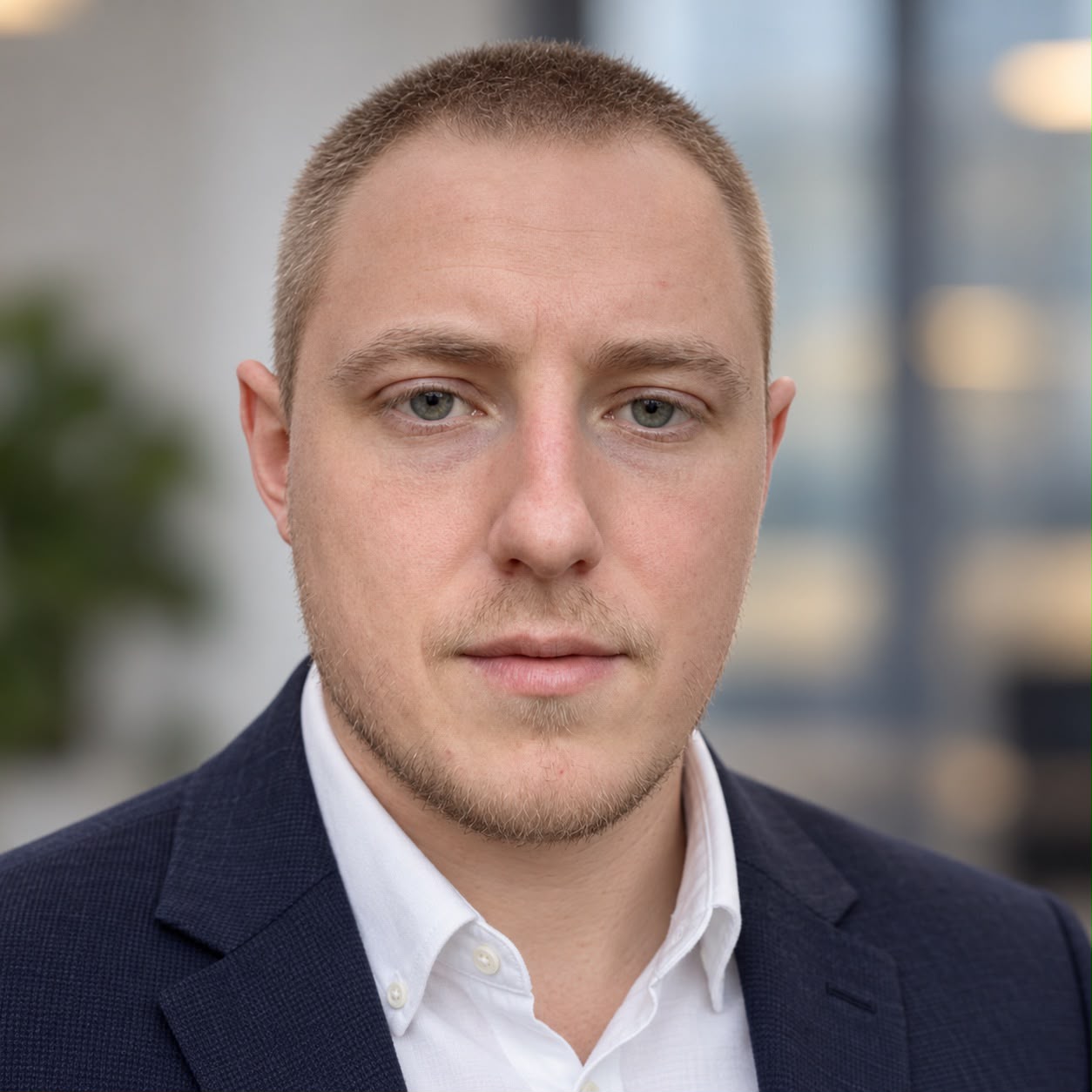
Building systems, not just experimenting with AI
Jamie — known as Jay — is a software engineer with a strong practical focus on AI systems, backend development, automation, integrations and application architecture .
His approach is hands-on. Rather than treating AI as a standalone technology, Jay focuses on how models, software, databases, APIs and infrastructure can be combined into complete working systems.
That includes understanding what happens before an AI model is called, how information is processed and validated, what happens when a model is uncertain, how systems communicate with each other and how the finished application can be deployed and operated reliably.
One of Jay's strongest technical areas is local language models. He has spent considerable time working with and testing open-source models, understanding how they perform on different hardware and where they can be used instead of automatically sending business data to a large cloud-based AI service.
This includes selecting models, configuring local inference environments, testing different model sizes and quantisations, measuring performance and understanding the trade-offs between accuracy, speed, memory, compute requirements, privacy, cost and energy consumption.
That expertise is particularly important to Rare² because the company does not believe every task should automatically be given to the biggest available AI model.
The right level of intelligence for the job
Jay's local-AI expertise complements Rare²'s wider approach of using the least complex technology capable of completing a task reliably.
A business process may be handled entirely with deterministic code. Another may require a small local model. More difficult work may need a larger local model, a frontier model or human review.
The technical challenge is not simply getting an AI model to produce an answer. It is designing the complete system so that each piece of work can be processed efficiently, accurately and safely.
Use AI where it improves the system — not simply because AI is available.
Jay works from the technical requirements backwards. What information comes in? What result is required? What level of accuracy is acceptable? How quickly must it happen? Does the information need to remain local? What happens when something fails?
The objective is a dependable operational system rather than an impressive AI demonstration.
From concept to working software
Jay has independently developed software products including ReplyBack, demonstrating the ability to take an idea through architecture, development, integration and deployment.
Within Rare², he works across the technical development of bespoke applications, AI workflows, backend services, integrations and local-model infrastructure.
He is also heavily involved in the company's work around comparing conventional code, small local models, larger local models and frontier AI to establish which processing route is appropriate for a particular business workload.
What Jay does at Rare²
Jay leads much of the deeper technical engineering behind Rare². His responsibilities include software architecture, backend engineering, AI integration, local LLM infrastructure, application development, system integrations, testing and production deployment .
He works closely with John when turning a business problem into a technical system: taking the process and commercial requirements identified during discovery and determining how the underlying software should actually be engineered.
This gives Rare² an important capability in-house: the people identifying the problem and designing the solution are working directly with the person responsible for building the underlying technology.
The combination matters. Technical skill without commercial judgement produces automation nobody needed. Commercial insight without technical delivery produces a plan that never ships.
Our approach
Automation must earn its place. We only automate where the solution creates a credible practical return. If a process does not cost you enough in time, money, errors or lost opportunities to justify the work, we will say so rather than sell you a system.
Human oversight stays where it matters. Important decisions can remain subject to human review and approval. The objective is to remove repetitive work while retaining appropriate control, accountability and judgement.
Plain language over jargon. You should not need to understand the technology to understand what we are proposing, what it will change and what it is worth.
Who we work with
The solution is determined by the process, not restricted to one industry. The businesses we can help most are those with repeated administration, disconnected systems, high enquiry volumes or tasks that must be completed consistently. Our approach can be applied across different industries, but our current focus is manufacturing and engineering businesses across the North West.
Show us what wastes your time.
Tell us about one repetitive process. We will assess whether it can be improved through automation.