
A customer emails asking for a price. How long they wait for your answer can decide whether you win the job. So how quickly should you respond to an email enquiry? The short answer is within an hour, and sooner if you can.
Below is what the research says about lead response time, why enquiries go cold, five practical ways to reply faster, what to put in the reply, and a worked example.
- ✓Aim to respond to an email enquiry within an hour during working hours. For a straight price or availability question, minutes is better.
- ✓In a Harvard Business Review audit, companies that responded within an hour were nearly seven times as likely to qualify the lead.
- ✓The biggest leaks are slow first replies, missing phone numbers and no follow-up.
- ✓A fast first reply doesn’t need to be a full quote. It needs to answer what it can and set the next step.
The short answer
How quickly should you respond to an email?
Respond to an email enquiry within an hour if you can, and within minutes if it’s a direct price or availability question. For a customer or sales email, the same working day is the latest a reply should arrive. The customer’s interest is highest at the moment they get in touch, and the first business to give a useful answer is often the one that wins the work.
The research
Lead response time: what the research found
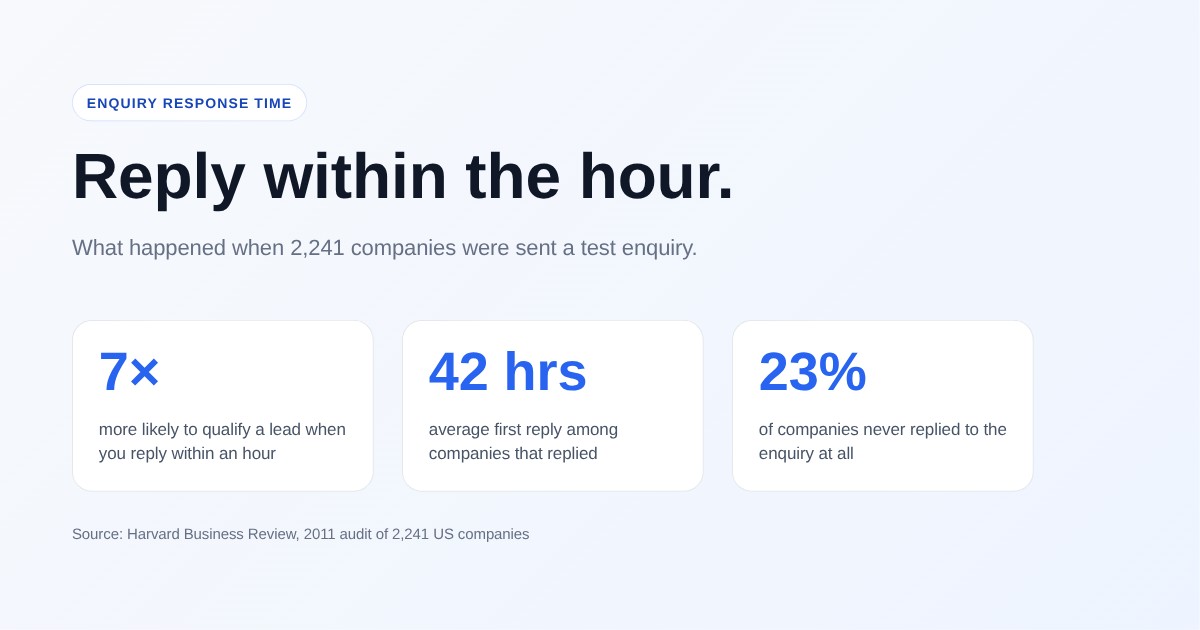
7× Companies that contacted a lead within an hour were nearly seven times as likely to qualify it as those that waited longer. | 42 hrs The average first response among companies that replied within 30 days. | 23% The share of companies that never responded at all. |
Those figures come from The Short Life of Online Sales Leads, published in Harvard Business Review in 2011. The researchers audited 2,241 US companies by sending them test enquiries and timing the replies. It’s an older, US-based study, but the pattern will be familiar to any UK business that wins work by email.
Where enquiries leak
Why enquiries go cold
Most businesses don’t ignore enquiries on purpose. They slip for ordinary reasons:
01 Buried in the inbox Enquiries arrive alongside invoices, newsletters and supplier emails. The urgent ones don’t stand out, so they wait. | 02 The reply needs a price Working out a price and writing a proper answer takes time you don’t have mid-job, so it gets pushed to tonight, then tomorrow. |
03 No phone number Without a number, email is the only way back. If the customer doesn’t reply, the conversation simply stops. | 04 Nobody follows up When a customer goes quiet, the enquiry is often never chased. Yet a quiet customer may simply have been busy. |
What to do
Five ways to respond to email enquiries faster
None of these need new software. They’re habits, and each one closes a specific leak:
01 Use one enquiries address Send website forms and quote requests to a single mailbox, so nothing gets lost across personal inboxes. | 02 Set a reply target Decide what “fast” means for you, such as within an hour in working hours, and check which enquiries are past it. | 03 Have your prices ready Keep a simple price list for your most common questions, so a first reply can answer them straight away. |
04 Ask for a phone number If they didn’t leave one, ask in your first reply. A call is often the quickest way to turn interest into an order. | 05 Follow up on a schedule Decide in advance when you’ll check in, for example after two days and again after a week, and stop as soon as they reply. |
The reply itself
How to respond to an email enquiry
A fast reply only helps if it moves things forward. A good first reply to an email enquiry does five things:
- Thanks the customer by name, so it reads as a reply from a person rather than an automatic acknowledgement.
- Answers the question they asked, such as a price or availability, as far as you can.
- Says what happens next, for example when a full quote will follow.
- Asks for a phone number if they didn’t leave one.
- Signs off with your name, phone number and opening hours.
Keep it short. The customer wants an answer and a next step, not a brochure.
Worked example
What a fast reply looks like in practice
Here’s a typical evening enquiry for a print shop, handled with the steps above. The customer and prices are made up.
| 7:42pm | Email arrives “How much for 500 business cards? Need them by Friday.” No phone number left. |
| 7:43pm | Read and sorted A price question with a deadline: a hot lead. The owner gets an alert. |
| 7:46pm | First reply ready The price for 500 cards from the price list, a line confirming the Friday deadline, and a request for the best number to call. |
| Next day, 10am | Polite chaser No answer yet, so a short message goes out mentioning they got in touch yesterday. |
| Customer replies | Follow-ups stop The chasers stop automatically and the enquiry moves on to a quote. |
That’s the whole first exchange done before the shop opens the next morning. You can do it by hand with the five steps above, or let Rare² Enquiries do it automatically.
Automation
Can you automate replies to enquiries?
Yes, and it doesn’t mean handing your inbox over to a robot. These parts are safe to automate because they follow clear rules:
- Reading each enquiry and sorting the hot leads from the rest.
- First replies to common questions, using your own prices and website.
- Asking for a phone number when the customer didn’t leave one.
- Follow-ups that stop the moment the customer replies.
- Alerts when a hot enquiry lands, so you can pick up the phone.
What should stay with you is anything that needs judgement: complex quotes, complaints and negotiation. A good system starts with drafts you approve, and only sends on its own once you trust what it writes.
That’s exactly how Rare² Enquiries works. It sits on the mailbox you already use, learns your website and prices, and lets you choose for each step whether it drafts or sends.
FAQ
Questions about email response times
How long should a business take to respond to an email?
Within an hour during working hours, and within minutes for straightforward price or availability questions. A Harvard Business Review audit found companies that responded within an hour were nearly seven times as likely to qualify the lead as those that waited longer.
What is a reasonable email response time?
For a sales or customer enquiry, aim for within an hour during working hours and no later than the same working day. For internal or non-urgent email, replying within one working day is usually reasonable.
Is an automatic “we’ve received your email” message enough?
Not really. An acknowledgement tells the customer you exist, but it doesn’t answer anything. A useful first reply answers what it can, such as a price from your list, and sets the next step.
How many times should you follow up an enquiry?
Two or three polite follow-ups, spaced a few days apart, is a sensible default. Stop as soon as the customer replies, and make each message useful rather than a bare “just checking in”.
What if I can’t give a price straight away?
Reply anyway. Thank them, say what you need to quote accurately and when they’ll have it. A quick holding reply with a clear next step is far better than silence.
Can AI reply to customer enquiries?
Yes, if it is set up with your own information. Rare² Enquiries drafts replies using only your website and price list, and you can approve each one before it is sent.
Never leave an enquiry waiting again
Rare² Enquiries reads every email enquiry as it lands, sorts the hot leads, drafts a reply from your own prices and follows up until the customer answers. You can start with drafts you approve, and switch to automatic when you’re happy.
See Rare² EnquiriesBook a free review